Issue No. 12 | Employee Handbook vs. Company Policies: What’s the Difference?
Most small business owners use the words “handbook” and “policies” interchangeably — but they’re actually two very different tools. And in my humble opinion, that’s part of the reason handbooks often don’t get as much buy-in as they should.
This is something I saw regularly when I was working as an in-house HR Manager. There were more than a few companies I worked for that had a binder full of policies and called it their “company handbook.” Something I quickly changed and put my stamp on 😉
Once you know the difference, creating a small business employee handbook and a set of company policies becomes a whole lot easier and stress-free
Let’s dive into the what’s and what nots, the should’s and should nots, of handbooks and policies.
What Is an Employee Handbook?
Think of your employee handbook as a guidebook for how your business operates. It’s not a legal document. It’s not a rule book. It’s not 87 pages. And it definitely shouldn’t read like a law textbook.
An employee handbook should include:
Who you are (mission, values, culture)
Your company history and why you do what you do
How your team works together
Communication expectations
A high-level overview of time off, scheduling, and payroll
What it’s like to work at your business
A welcome + orientation-style introduction
The purpose of a handbook:
Your employee handbook helps new hires understand how things work. It sets the tone, builds connection, and creates clarity.
Your handbook should feel human and like it’s written in your company voice. It should not read like a corporate template, meant for big business or written by a stiff CEO (no offense)
What Are Company Policies?
Policies are specific rules, standards, and expectations for your team to follow. They protect your business, keep you compliant, and provide clarity.
Key points about policies
Typically 1–3 pages each
Separate, stand-alone documents
Cover topics like: vacation and leaves, health & safety, benefits & payroll, code of conduct, remote work, discipline/performance processes, and government-required policies (varies by province)
The purpose of policies
Policies truly are created to provide clarity, avoid misunderstandings or grey areas, and ultimately reduce risk. They are more formal, more specific, and more detailed than handbooks, but there is still plenty of opportunity to use your company voice and have them fit your culture.
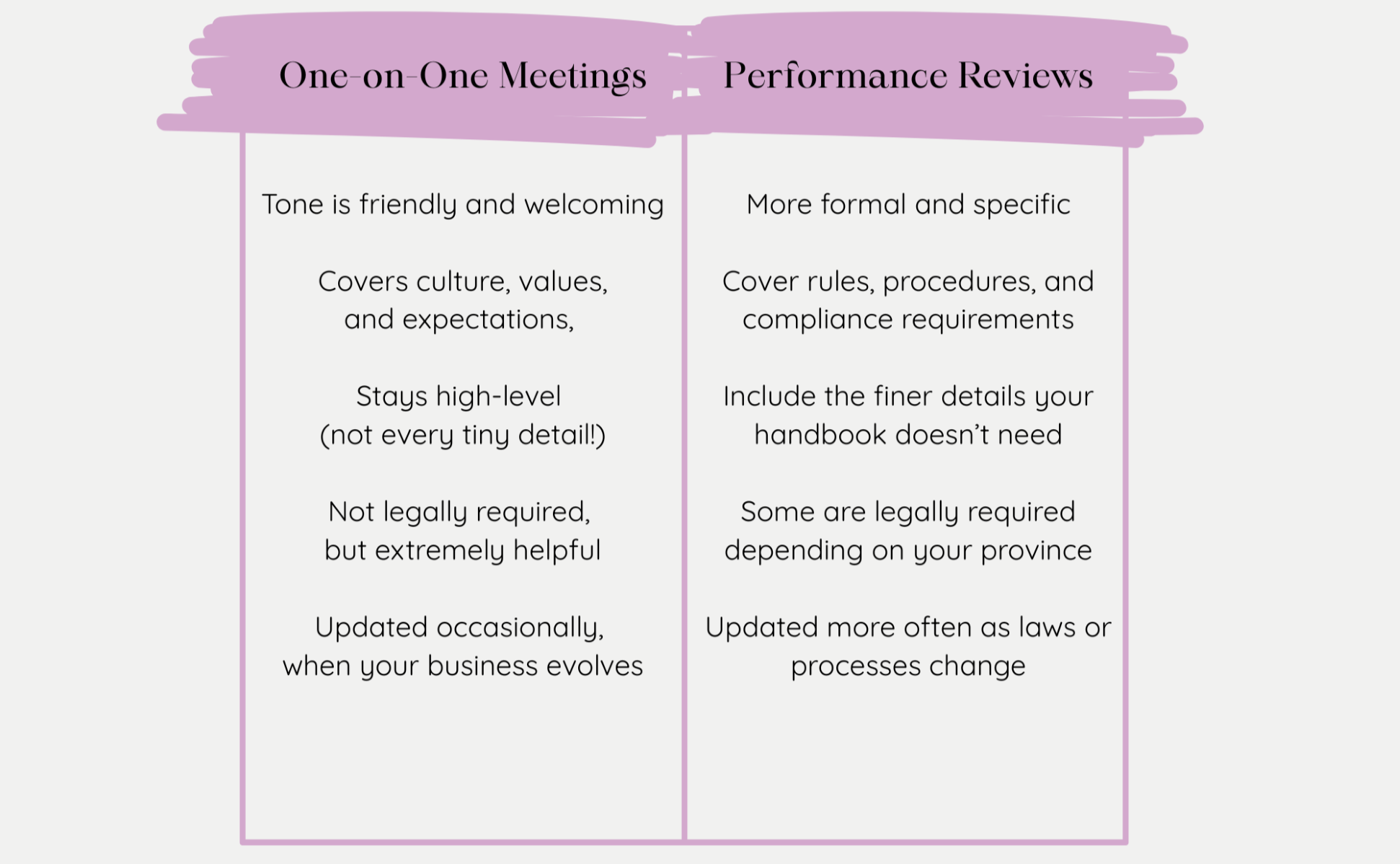
The Key Differences
How Small Businesses Get This Wrong
When small businesses mix up handbooks and policies — or treat them as the same thing — the information stops reaching your team. You end up with:
A handbook that reads like a thick, heavy legal binder no one will ever read
Policies buried where no one can find them (and let’s be honest, no one is looking)
Or, worse, you might have nothing written down at all. When that happens, employees start creating their own version of “how things are done,” which leads to confusion, inconsistent decisions, and unnecessary friction.
How Handbooks + Policies Work Together
Your employee handbook sets the tone (or vibe if that’s your preference), and your company policies support it. Include a high-level summary of each policy in your handbook.
Example: Vacation Policy
Handbook: “We encourage work-life balance. We offer paid vacation so you can rest and recharge.”
Policy: Accrual rate, eligibility, blackout dates, request steps, etc.
One gives clarity. The other provides rules.
What Small Businesses Actually Need
You do not need 22 policies and a handbook the size of a novel. Most small businesses only need:
A short, clean employee handbook
A small set of foundational company policies
A place to store and share them
A system to keep them updated
Clear communication with your team
That’s it. That’s all — at least for now.
Keep HR Simple and Effective
Your business doesn’t need complicated HR. You just need clarity, consistency, and tools that actually support your team and how you run your business. Start with the essentials, update as you grow, and ignore any advice that feels too “corporate” for where your business is right now.
And if you want help creating a clean, modern handbook or policy set — without the jargon, overwhelm, or legalese?
I build these for small business owners every day, and I’d be happy to help.