Issue No. 07 | One-on-One Meetings vs. Performance Reviews: The Best Option for Small Businesses
If you’re a small business owner trying to figure out how to support your team, you’ve probably heard the same two pieces of advice over and over: “Do regular one-on-one meetings” and “Run annual performance reviews.”
And if you’re sitting there thinking …do I really need to do both? You’re in the right place.
Spoiler alert…you don’t!
As a former HR Manager who has designed performance review systems, trained people on them, and survived more review seasons than I care to count, I can confidently say this:
✔ Small businesses do NOT need both.
✔ And if you’re going to pick one, choose one-on-one meetings every single time.
Keep reading for a heavily biased review of why one-on-one meetings vs. performance reviews isn’t even a fair fight—and why it’s time for performance reviews to ride off into the sunset.
What One-on-One Meetings Actually Do (And Why They're My Preference)
If you want to truly understand what your team needs, build trust, and keep communication flowing—one-on-one meetings are your secret weapon.
These meetings are:
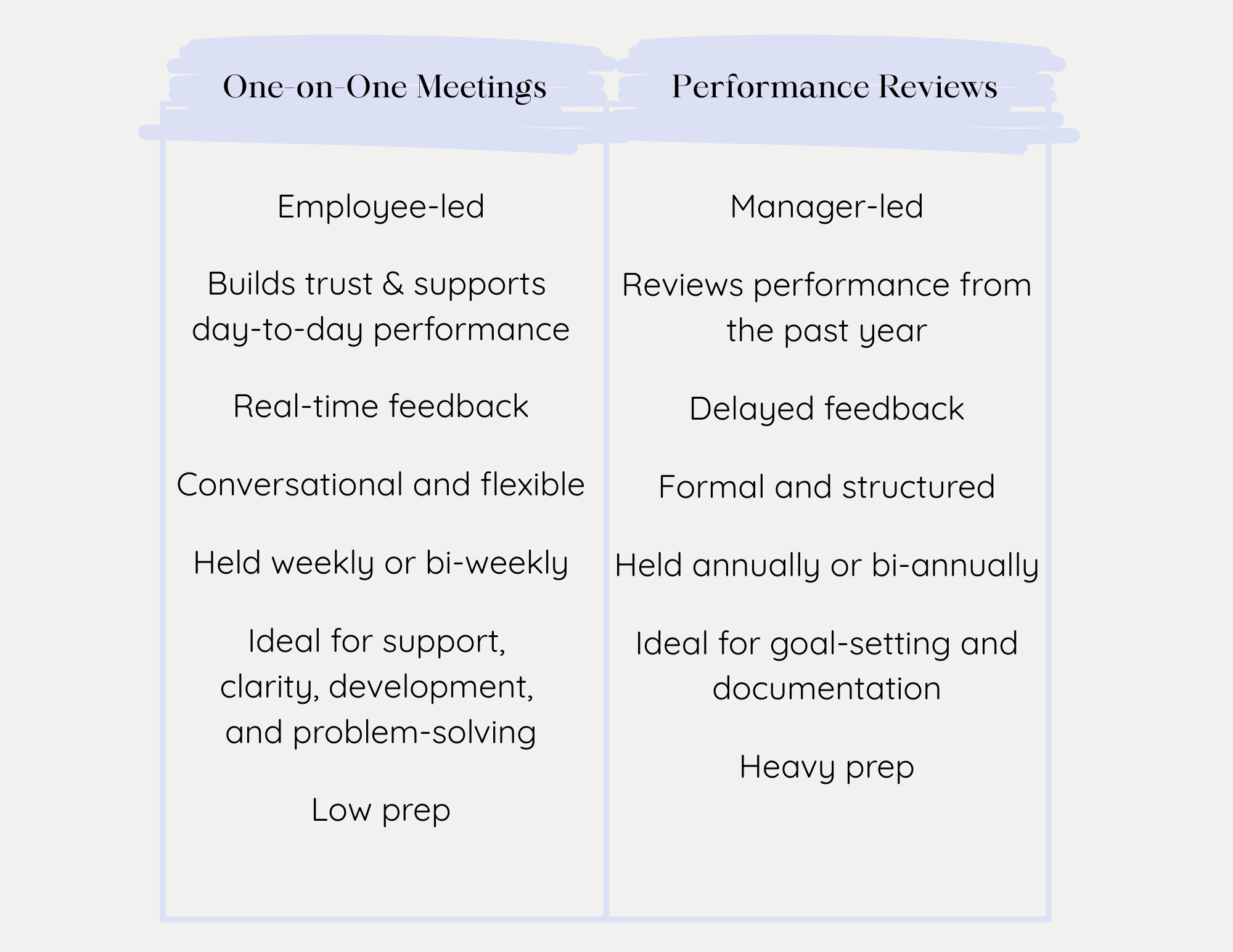
Employee-led (yes, that’s intentional)
Casual and conversational
Focused on support, clarity, and problem-solving
Held regularly (weekly or bi-weekly is most common, but monthly can work too)
Designed to strengthen the relationship, not grade performance
During a proper one-on-one, your employee brings the topics—questions, ideas, challenges, and anything they need help with. Your job? To listen, guide, coach, and unblock.
This is NOT the time for:
Status updates
Surprise feedback
Hidden agendas
Mini performance reviews
One-on-ones are all about real-time connection and real-time support—the exact thing small business teams need most.
And unlike performance reviews, you don’t need to block your calendar, fill out forms, or rate anyone on whether they "exceed expectations."
What Performance Reviews Are Supposed to Do
Performance reviews were originally designed to:
Look at the “big picture” of someone’s work
Document performance over a year
Set goals
Align development with company objectives
Help determine raises or promotions
Now, in theory this all sounds well and good. But in practice? For most small businesses, it’s overkill — and far from effective.
Performance reviews are:
Manager-led
Annual or bi-annual
Formal and process-heavy
Time-consuming (hello, prep season)
Often outdated and awkward for everyone involved
By the time a performance review happens, the feedback is already old.
The moment has passed. The context has faded. The impact is gone.
Small businesses move too fast for that.
Here’s a side-by-side comparison…
So…What Do Small Businesses Actually Need?
Here’s my honest, HR-informed opinion:
👉 Regular one-on-one meetings will always have a bigger impact on performance, growth, and employee engagement than any annual performance review ever will.
When you meet regularly:
• Problems get solved sooner
• Expectations stay clear
• Feedback becomes normal, not scary
• People feel seen and supported
• You avoid surprise issues
• And your team actually gets better at their jobs—in real time
Performance reviews?
They’re a ton of work, rarely executed well, and often leave employees feeling judged rather than developed.
Most small business owners think they need performance reviews because "that’s what businesses do." But the truth is:
✔ You do not need both
✔ You do not need a traditional performance review system
✔ You can lead your team effectively without ever filling out a rating scale again
If You’re Going to Choose One—Choose One-on-Ones
If you’re a small business owner building leadership systems from scratch, start with one-on-one meetings. They’re simple, effective, and incredibly powerful.
And if you’re thinking, "Okay, okay, but how do I run them without it feeling awkward or turning into a status update?"
I’ve got you.
I created a simple Guide One-on-One Meeting that breaks down exactly what to do, what to ask, and how to make these meetings something your employees actually look forward to.